For a single system we specify and and calculate the multiplicity . The probability of every microstate is .
For two systems (with thermal contact) consider two boxes with properties and . The energy can be exchanged, but the number of particles not. Together they make an isolated system:
- change of energy of 1
- change of energy of 2 ()
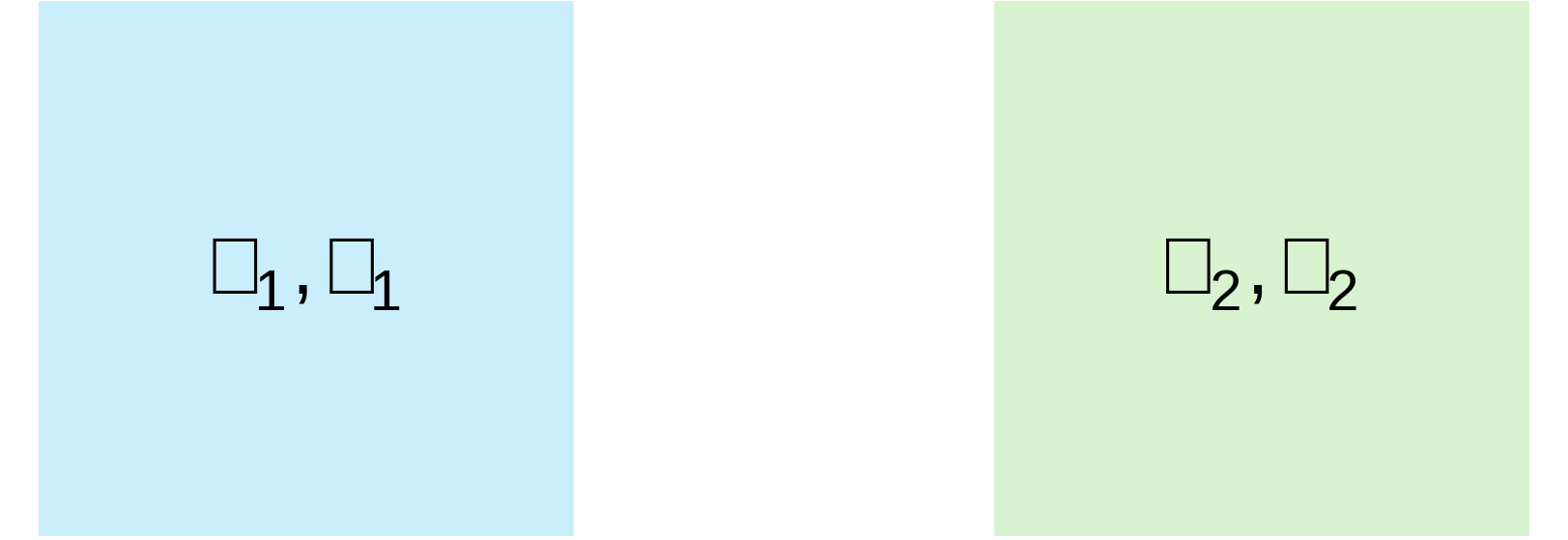
Thermal Equilibrium
Before the contact we know the multiplicity is .
The function is sharply peaked around the most probable configuration at . This state is also called equilibrium. Because is an extremal of
The change in must be
We define the entropy such that
when 1 is in thermal equilibrium with 2.
From it follows that .
- energy flows from 2 to 1
- energy flows from 1 to 2
The fundamental temperatur is
and differs from the kelvin scale by the Boltzman const
In classical thermodynamics we have with the classical entropy.
Consider atoms with states and with . The number of microscopic states is
If we turn on a magnetic field , for a single magnet .
- aligned with
- antialigned with
The total energy is
In a thermally isolated magnet, is conserved. If we have a second box (with ) in thermal contact. Now only the total energy is conserverd: .
To find the maximum at we have that
and . The multiplicity in the most probable state is
where
Fluctuations around the most probable state
Consider and . Then
Classical Thermodyamics
If system 1 is in thermal equilibrium with system 2 and system 2 is in thermal equilibrium with system 3, then system 1 will be in thermal equilibrium with syste 3.
Heat is a form of energy and energy is conserved.
In a closed system entropy tends to stay the same or increase.
This means that we have irreversible process because the number of microstates and thus a large entropy is much much bigger then all other microstates.
As the temperature approaches absolute zero, the entropy approaches a constant.
Boltzmann distribution
We assume that the reservoir is much larger than the system. The system itself cn be microscopic or macroscopic. We can view the system + reservoir as a closed system. The energy of the system can fluctuate but it comes from the reservoir.
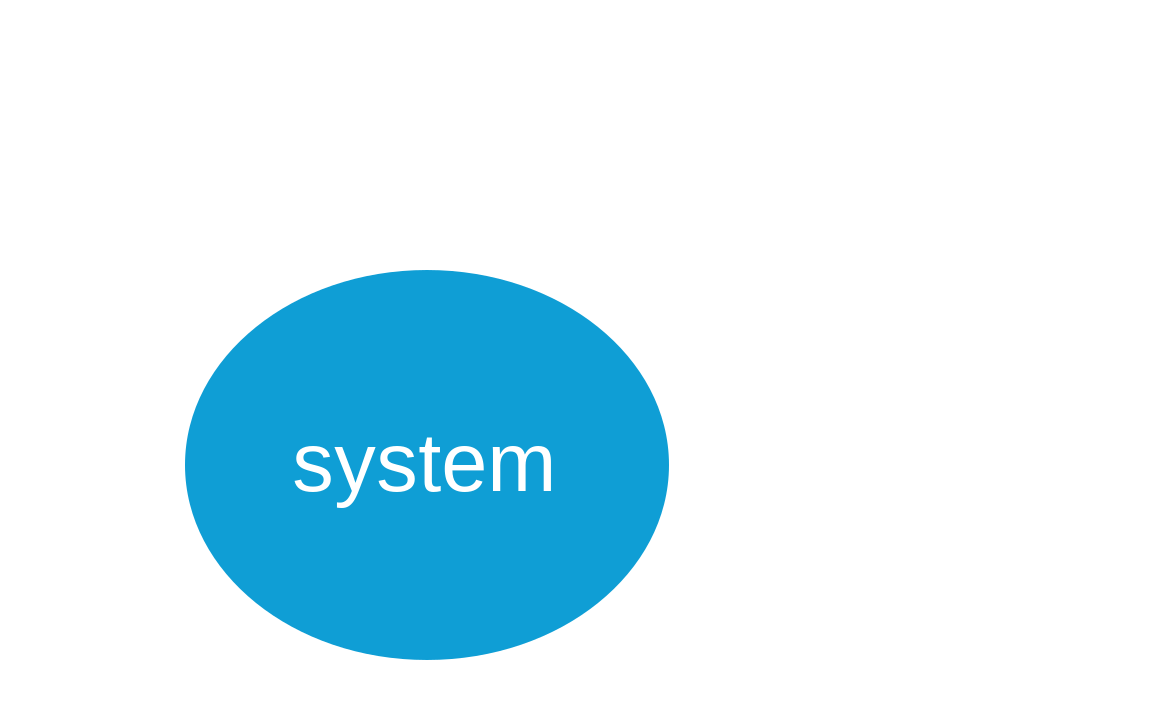
Consider a system with two states . The Probability of finding the system in these states is
We can approximate . The energy and the entropy is proportional to the volume. That means for .
where is the temperature of the reservoir.
For any state of the system with energy , the probability of this state is
If the system is dominantly in and for the system is equally likely in .
The probabilitiy of finding the system in state is normalized and given by
The average energy is
Consider and then and
The specific heat capacity is
Pressure
We have a system filled with gas and a piston pushing into a distance . The Work is
The pressure is and the work thus . The change in energy is
This is a slow enough process such that the system stays in equilibrium while changing. i.e. the system is in the most probable state at all times.
Two important cases of reversible changes:
- Adiabatic (isoentropic): The system stays thermally isolated (not in any thermal contact)
- Isothermal: The system stays in thermal contact with the reservoir
For an adiabatic change, and the multiplicity doesn’t change.
This means that
Previously we had . Bringing it together gives
The first term corresponds to the head added/subtracted and the second one to work done by the system.
Helmholz free energy
The most probable state minimizes this helmholz free energy: . In a reservoir
The partition function of a system is with
The energy is . We want to minimize the Helmholz free energy to find the optimal .
We have and .
Open systems: reservoir changes temperature
Assume that volume is fixed. The helmholu free energy in differential form is
When the system is in equilibrium we defined temperature such that .
Using the thermodynamic identity we have
And changes when the temperature of the reservoir changes or we do work ( changes).