A microstate is a particular configuration of the microscopic properties of a system.
This proporties can be position and momentum of the particles.
A macrostate is a descriptioin of the macroscopic properties.
This properties can be volume, number of particles, pressure or temperature and are easier measurable. A single macrostate is consistent with many microstates but a single microstate speficies always a specific macrostate.
Let be the number of coins. Each coin is either heads or tails . These are microstates. denotes the number of tails and is a macrostate
- Microstate: , Macrostate:
- Microstate: , Macrostate:
- Microstate: , Macrostate:
- Microstate: , Macrostate:
- Microstate: , Macrostate:
- Microstate: , Macrostate:
- Microstate: , Macrostate:
- Microstate: , Macrostate:
- Microstate: , Macrostate:
- Microstate: , Macrostate:
- Microstate: , Macrostate:
- Microstate: , Macrostate:
- Microstate: , Macrostate:
- Microstate: , Macrostate:
- Microstate: , Macrostate:
- Microstate: , Macrostate:
Combinatorics and probability
Lets consider a single, discrete variable. The probability tells us how likely it is to have a microstate. has the properties
The average value (also mean or expectation value) of is
In the continous case we change from a sum to an integral. Now tells us the probability of the variable being between and (this is the resultion of the measurement physically speaking). The properties are
The average value is
Counting
We consider identical (but distinguishable) objects with states. If we have
- objects in state
- objects in state
- and so on
Where is the total number of objects. We can calculate the number of ways to put objects in state and in state with the binomial coefficiant In general for states we have a total number of microstates of
Thermodynamic equilibrium
For a closed system with a fixed set of global contraint, every microstate that satisfies these constraints has an equal probability of being occupied.
A closed system cannot exchange mass with the outside but it can exchange energy. A system where this postulate is true is in thermodynamic equillibrium.
The macrostate occupied in thermodynamic equillibrium is the one with the largest number of microstates.
The ergodic hypothesis says that over a long time the system will sample each microstate with equal probability. The system does a so called “random walk” between the different microstates.
We again let be the number of coins. We want to find the probability of getting the microstate (). After flips we have
where
- is the probability of after flips
- is the probabilty of chosing the -coin and flipping it to a
If we let we have .
Similarly we get and by symmetry and . Together with we have a system of equation, that yields (when solved)
This is a binomial distribution with a standard deviation of and a fractional width of . The second postulate is very good for big .
Temperature and Entropy
Imagine a box with two sides with or particles and energies of or .
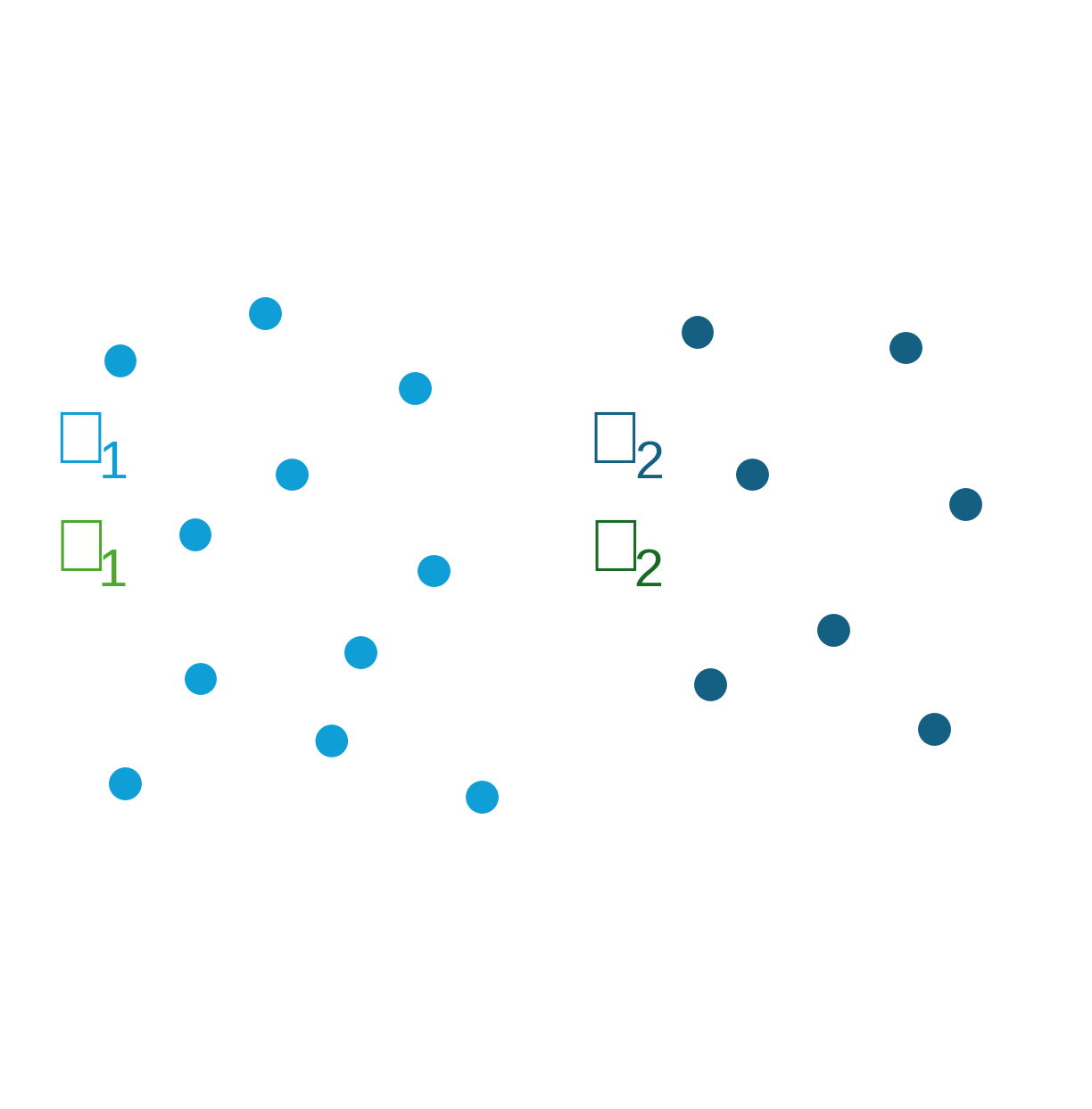
The total energy is . This is a global constraint. Let be the number of microstates specified by particles and an energy of (). The total number of microstates is
Where and are fixed. To maximize (for second postulate) we calculate
We define and can simplify to
and in thermal equilibrium they are in fact equal.
Let be the temperature such that
where the number of particles and the volume are constant. .
We let . Another important quantity is the entropy
The temperature is therefore
Laws of thermodynamics
Two system in thermal equilibrium have the same temperature.
Heat is a form of energy. And the energy is conserved, thus
we write , where we write for when the heat applied depends on not just the state before and after, but how the change happend.
The entropy of an isolated systems never decreases.
In an isolated system no particles or energy can be exchanged with the outside.
The entropy of a closed system approchs a constant value as the temperature approaches zero.
More about the laws of thermodynamics in the physics I lecture.
Boltzman factor and the partition function
We want to find out how the temperature affects the probability of finding a system in a microstate. Imagine a big bath (or reservoir) with particles and a system in that bath, which is in thermal equillibrium with the heat beath. The probability of finding the system in the two microstates isn’t equal altough we specified the microstate of the system.
Let be the temperature of the system. What is the probabilty of finding the system to be in a microstate with energy . At thermal equillibrium
The number of microstates is
Where is the probability that the system is in that microstate. i.e.
To find that we let and we look at the quotient
The probability of finding a system in thermal equillibrium in a microstate with energy is proportional to . This is called the Boltzmann factor.
To calculate the absolute probability of finding the system in a microstate with energy is
where is the set of all possible microstates.
All thermodynamically relevant microstate can be calculated from the partitial derivative of . We have
If we have atoms with atoms in state , atoms in state and so on. We have
microstates. To maximize with respect to the set we can maximize
with the constraints of and . Lets apply Lagrange multiplier
If we assume that is large we can use Sterlings approximation
This gives
where is the single particle partition function and .
Ideal gas
An ideal gas is made up of particles moving around individually with no interactions between the particles.
If we consider an ideal gas without an external potential the energy is
To calculate we need to sum over all possible microstate for and . The probability for between and between in 3D is
We get with the normalization condition
To macth the units we must devide by a constant (with turns out to be the planck constant)
For many distinguishable particles we have
For particles we have
Where represents the terms for states where more than one particle is in it. Those can be neglected in the classical limit. We approximate the partition function for indistinguishable particles to be
The average energy is
A single particle has theredore an average energy of .
Each term in the energy that is quadratic in some coordinate contributes to the average energy per particle.
A diatomic molecule in free space has an energy of
where
- is the motion for the center of mass
- is the vibrational motion in the direction
- are the two rotational modes
Maxwell-Boltzmann distribution
We want to find the distribution of the speed of the gas particles. We know that
The average value of is
The pressure of the gas on a wall normal to the -axis is
For atoms the -component of the velocity between and is the momentum transfer per particle and therefore . The time between collisions is . The pressure is
From this relation we get the ideal gas law
We devide the phase space into discrete units of planck’s constant. The number of states between and is the multiplicity factor
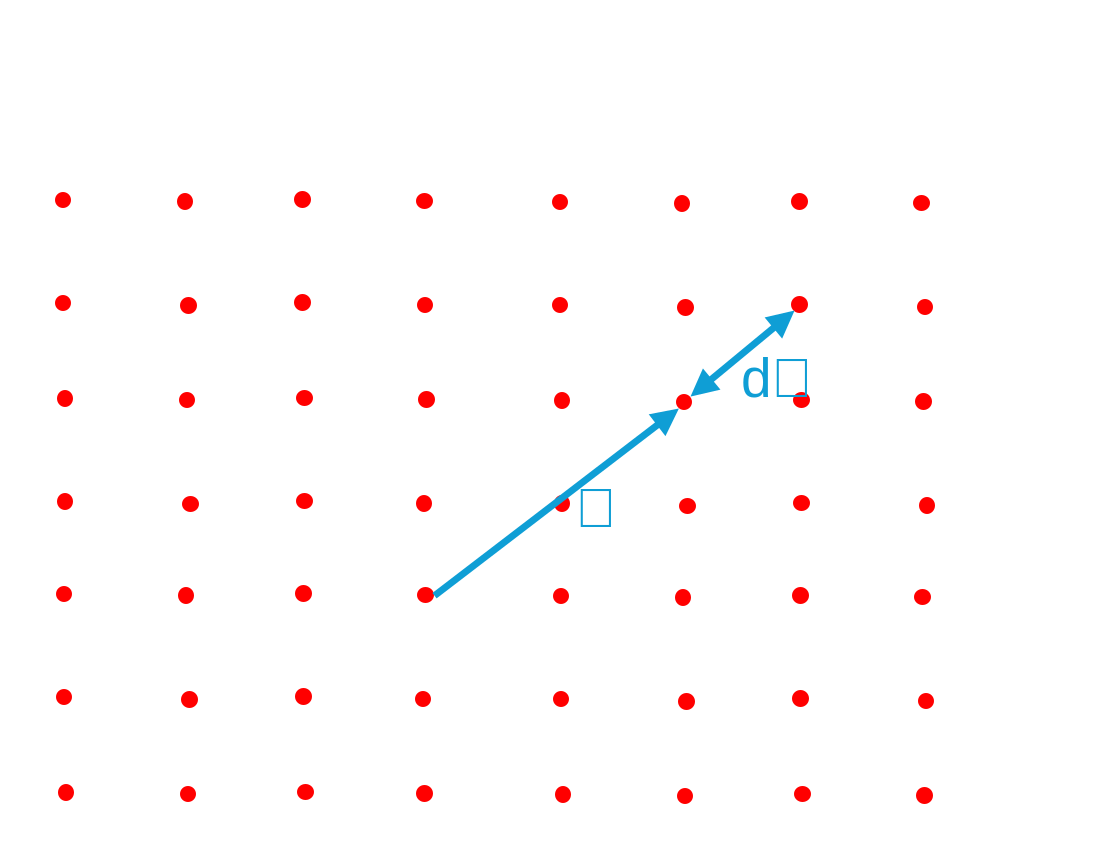
The probability of finding a particle with momentum between and is
If we multiply by and use we obtain the number of particles with speed between and
This is the maxwell-boltzmann distribution with an average velocity of
and an maximum velocity of
Blackbody
A true black body absorbes all radiation and is in equillibrium with the environment. Therefore it must emit radiation to not warm up continously. One of the best way to model a blackbody is a box at Thermodynamic equilibrium. All light inside the box is absorbed by its materials and the only radiation in the box is black body radiation.
For the waves inside we need to solve
Because there are no charges inside the box: and because it’s a metallic box the boundary condition is . If we consider a 1D box in the -direction the solutions to
are standing waves
with and for . has two possible polarization directions. Each solution is called a mode of the cavity with an amplitude . In 3D we have the solution
where
and . The Rayleigh-Jeans Law states that the energy of each mode (which depends on the amplitude and electric and magnetic field) is
And the equipartition theorem says that each mode has an average energy of
Putting all together gets us the average density inside the box in a range of frequency between and
With and we get a probability for the wavelength being between and
At high frequencies we experience a UV catastrophe because .