atomic spectra
In the atom there are different particles (protons and neutrons are further made out of quarks)
| name | charge | mass |
|---|---|---|
| proton | ||
| neutron | ||
| electron |

(image from franklyandjournal.wordpress.com accessed at 19.10.2025)
The pattern in spacing of the different wavelength is called balmer series
This is a special case of the series Rydberg found (for all frequencies even outside visible light)
for the balmer series and is called the Rydberg constant.
Nils Bohr thought that electrons are only allowed in some orbit sizes. It turns out that this description is not entirely true.
photoelectric effect
We have a current and we shine light on a metal plate with electrons. Those electrons get ejected and wander to the collector plate.
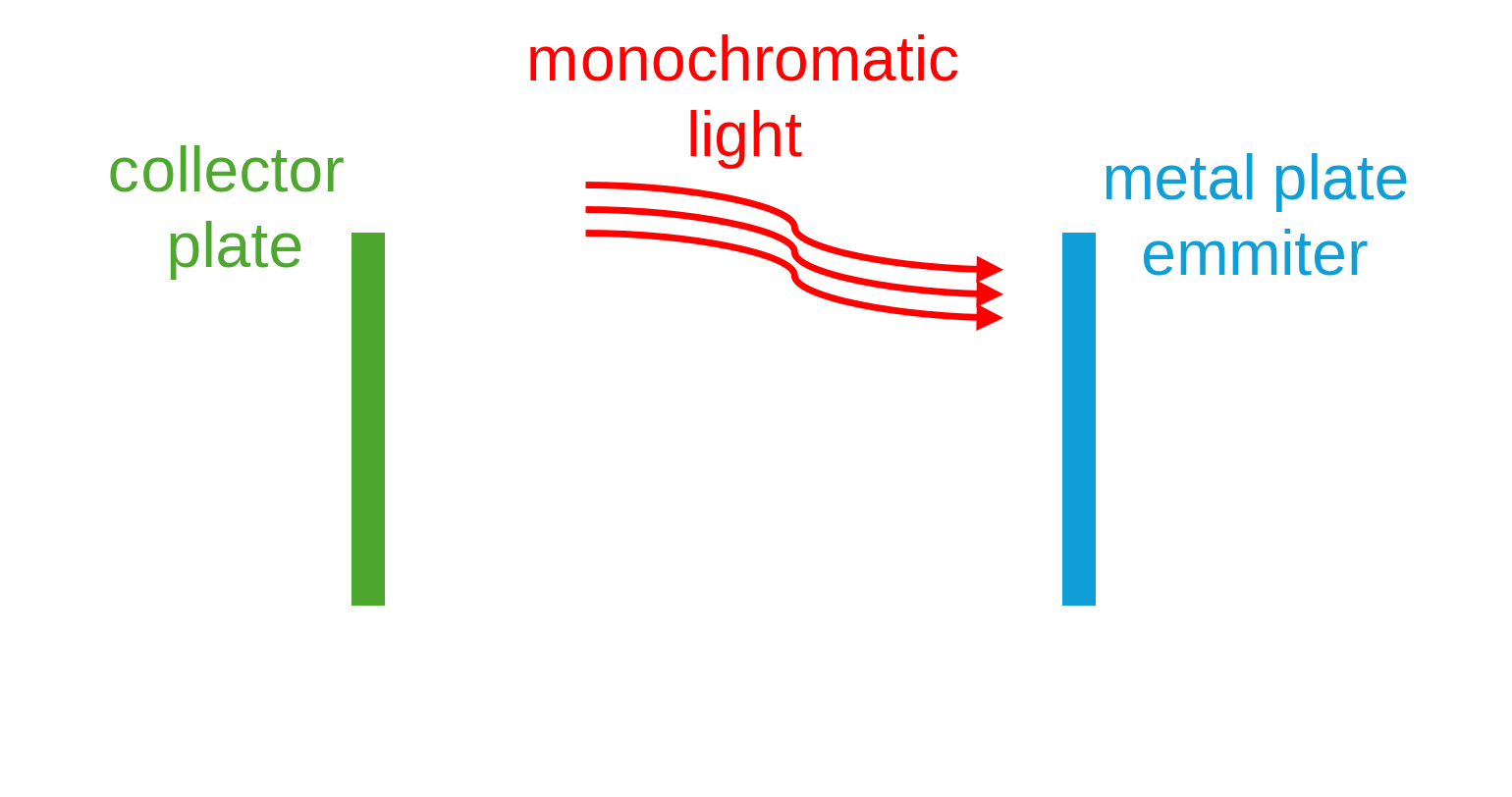
- light causes negative charges (electrons) to be ejected
- light does not cause positive charges to be ejected
- electrons are not ejected if frequency is too low
If we plot the maximal voltage the electrons get ejected and the corresponding frequency of light we get
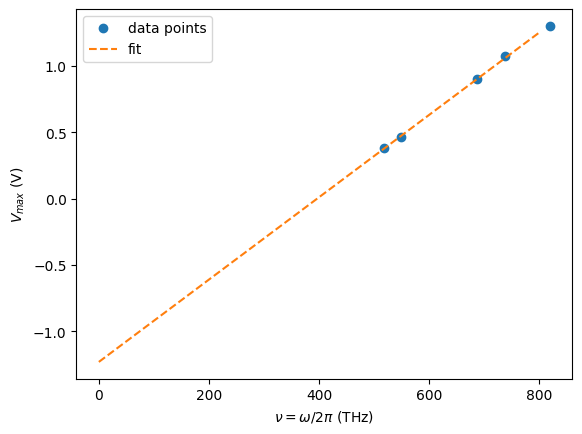
And we see a linearl dependence.
- plank constant:
- frequency of light:
- work function (specific for metal plate emmitter):
Einstein figured out that light of frequency has to travel in packets “quanta” of energy . These quanta are called photons.
If the photons can move.
rayleigh scattering
Rayleigh scattering happens when electromagnetic radiation is scattered elastically (same energy before and after) by atoms.
We can approximate the electron to a nucleus as a harmonic oscillator. For a EM wave with frequency and electric field we have the equation of motion
a solution is
This gets as a dipol moment . This dipol emits radiation (Herzian dipol) where the emitted electrical field is
our approximation for rayleigh scattering is good for where is in the UV range.
In this example we have a lattice of atoms in a crystal as the grating and the light is in the x-ray range.
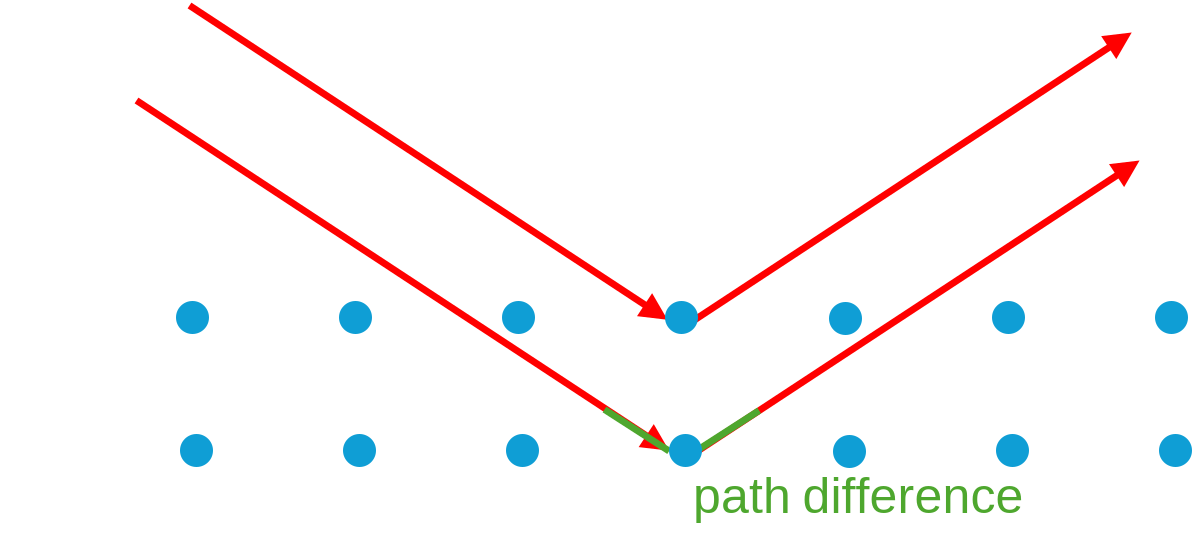
The phase difference is
For constructive interference we need
This is called the Bragg condition and Bragg scattering.
matter behaving as waves
We saw that electrons can form a similar diffraction pattern as light (waves) and thus the idea of electrons (or all matter) behaving as waves emerged.
We don’t experience this behaviour in every day light because if we accelerate an electron to the wavelength would only be . The diffraction pattern from a single slit is
with zeros where . That means that we would need an extremly narrow slit.
wavepackets
Classically we can say that the position of a particle (in 1D) is and is located at a particular point. For monochromatic waves we write
and the intensity pattern at an aperture is
We now make a wave package
Consider a range of wave vectors to and sum over all of them ()
This represents the partical in real space but if we take the Fourier transform we can describe it in -space
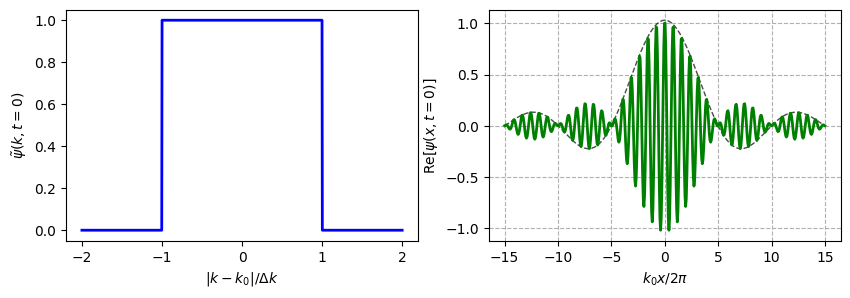
The peak of the part of is at
and the derivative at this point is the group velocity of the wave package. The width of the envolope is
We can interprate as a probability to find the particle at a particular point when observed. Therefore we want
to find the particle somewhere in space. Parsevals theorem gives and the amplitude has to be
Heisenbergs uncertainty principle
If we shoot particles through a slit of length we detect a intensity pattern. If is the -component of the momentum then
with minima at we get .
If and are defined as the standard derivations of the probability distributions in and we get
This says that we cannot simultaneously measure both the position and momentum with arbitrary precision.
Schrödingers equation
In quantum mechanics the Schrödinger equation tells us how and evolve over time (analogous to Newtons 2nd law)