In Astrophysics nearly all areas of physics are relevant.
Scales
| Kind of unit | Name | Symbol | Value |
|---|---|---|---|
| Mass | Solar mass | ||
| Length | Astronomical unit | ||
| Parsec | |||
| Time | Year |
One can remember how many seconds there are in a year as .
Comparissons:
- Mass of earth:
- Mass of galaxies: up to
- Radius of Milky Way:
- Thickness of Milky Way:
Celestial Coordinates
Equatorial coordinates
Origin: center of earth
Declination: with at the equator and at the north/south pole
Right ascention: with where the equatorial plane crosses the ecliptic one (in Aries constellation)
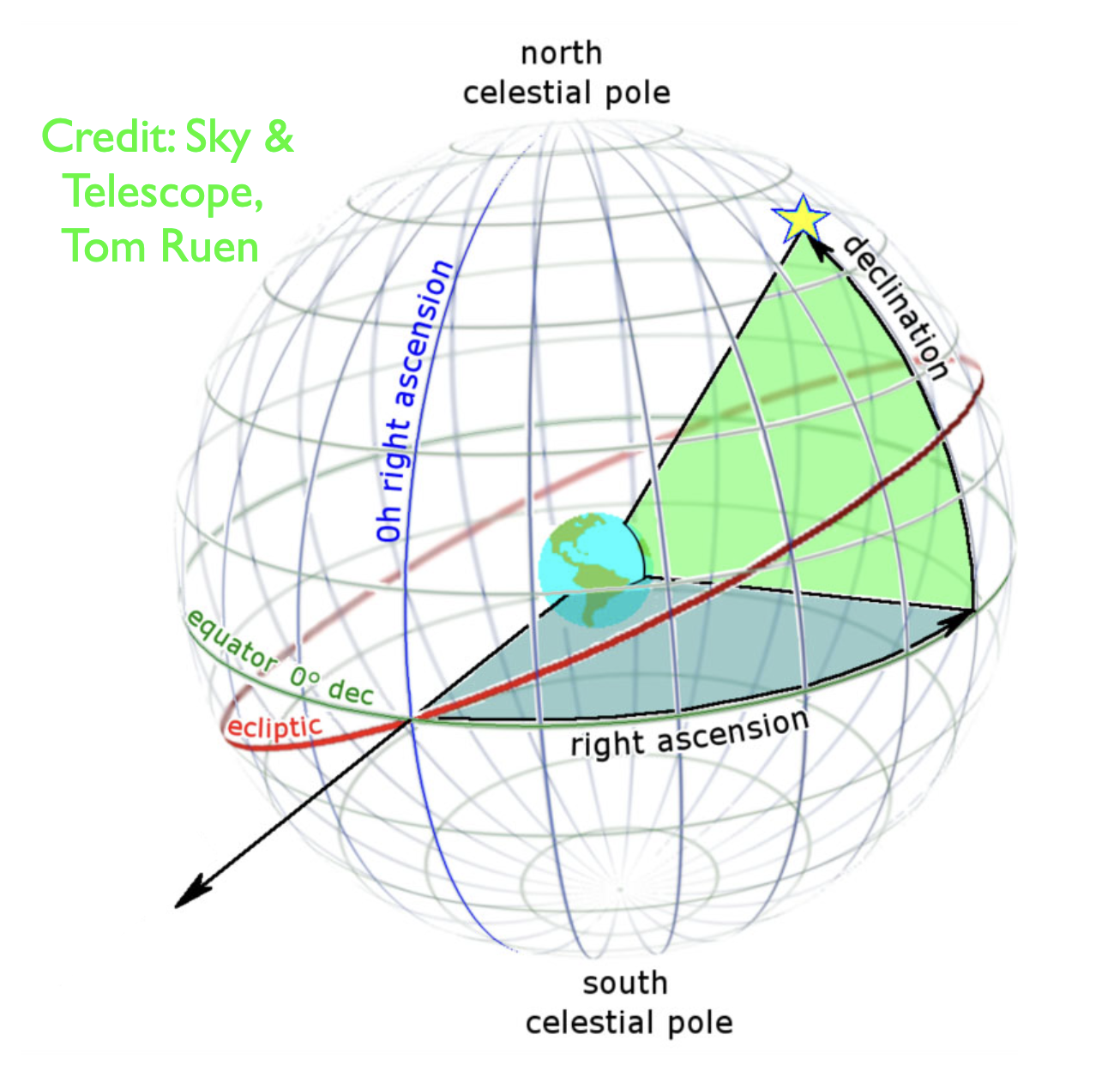
Here distance stars are fixed, but planets move.
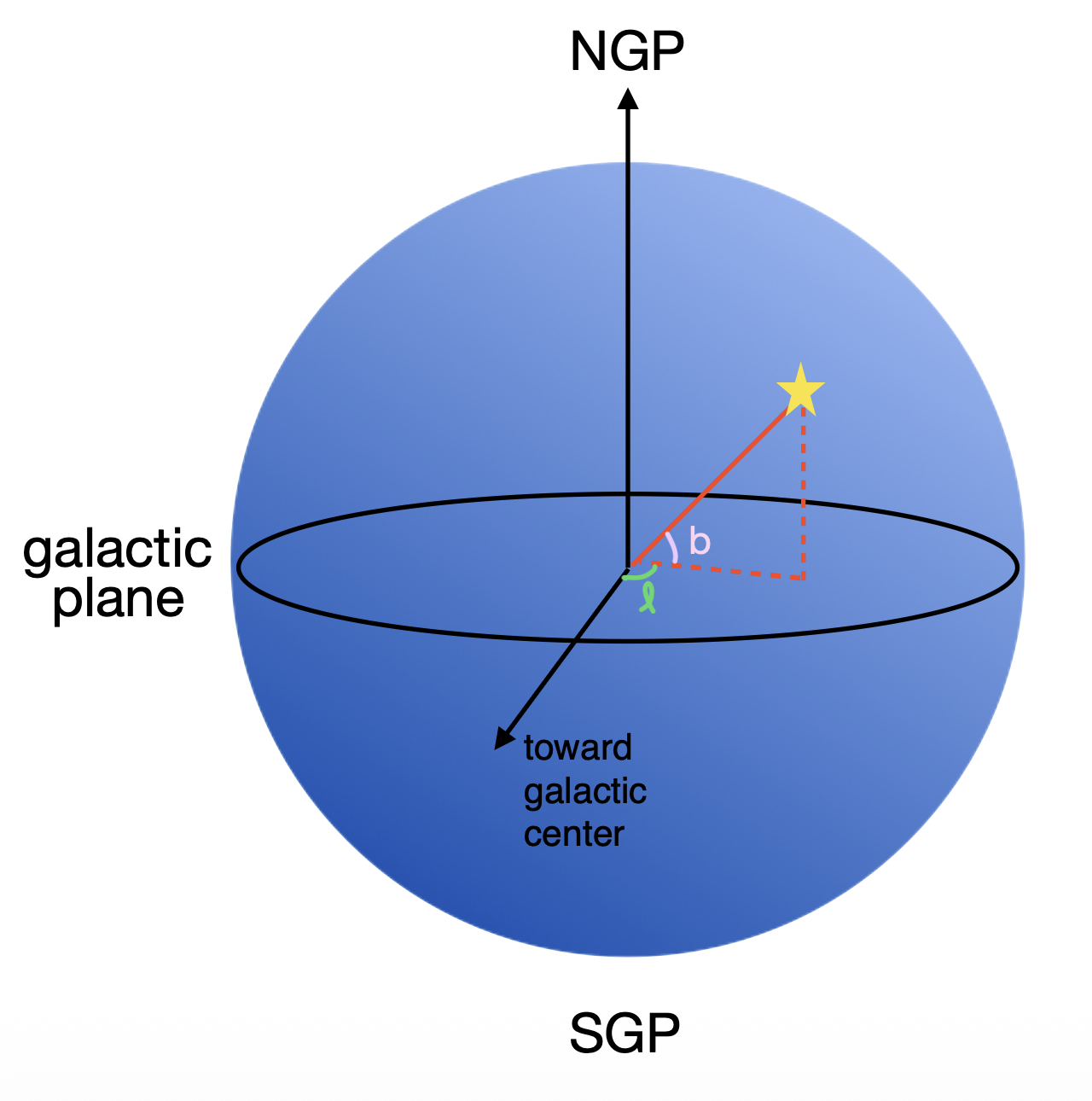
Galactic coordinates
Origin: Sun position (about from galactic center)
Galactic latitude:
Galactic longitude:
- galactic plane at
- galactic poles at
- galactic center in direction of
Magnitudes
Magnitudes describe the brightness of objects.
Consider a source at a distance from the observer.
- Luminosity: Energy per unit time emitted in all directions by the source: .
- Flux: Energy per unit area per unit time observed at a distance :
Whereas Luminosity is independant of the observer, the flux is not.
Consider 2 sources with fluxes and . Their apparent magnitude ist defined such that
The absolute magnitude is the appearent magnitude if it were placed at .
The appearent magnitudes need a value to compare it to. Brighter objects have a lower apparent magnitude.