In the beginning of the 20th century early thoughts about quantum mechanics were made.
Plancks radiation law
We start with the wave equation and Maxwells equations
By separation of variables we obtainn
for the spacial part. The boundary condition for results in
additionaly due to . The number of modes up to an index is
with and ( for polarization and because we only consider ). The density of states per volume is
Just computing the partition function and then the average energy would result in an infinite energy in the ultraviolet regime.
Planck proposed that the energy is discrete in packages of . The partition function is
The energydensity per mode () is
Bohr’s Quantum Hypothesis
Balmer empirically derived that the emitted light in a hydrogen atom has a frequency of
the energy is and the energy-levels are
with the Rydberg constant.
The angular momentum is quantized in packages of
Together with the angular momentum of a point mass in a circular orbit, energy conversation and the coulomb force
it follows that the bohr radius is
and the Rydberg constant is
For a general atom with charge and a nucleus of mass the Rydberg constant must be replaced by
Bound orbits of a Hamiltonian system with one degree of freedem but fulfill the following condition of its action
where the integral is taken over an orbit.
For an harmonic oszillator the energy is
Evaluating the integral above results in the area of an ellipse with axis and ( or )
This must be equal to . Thus we can conclude that
which is in agreement with Planck’s postulate.
Photoelectric effect
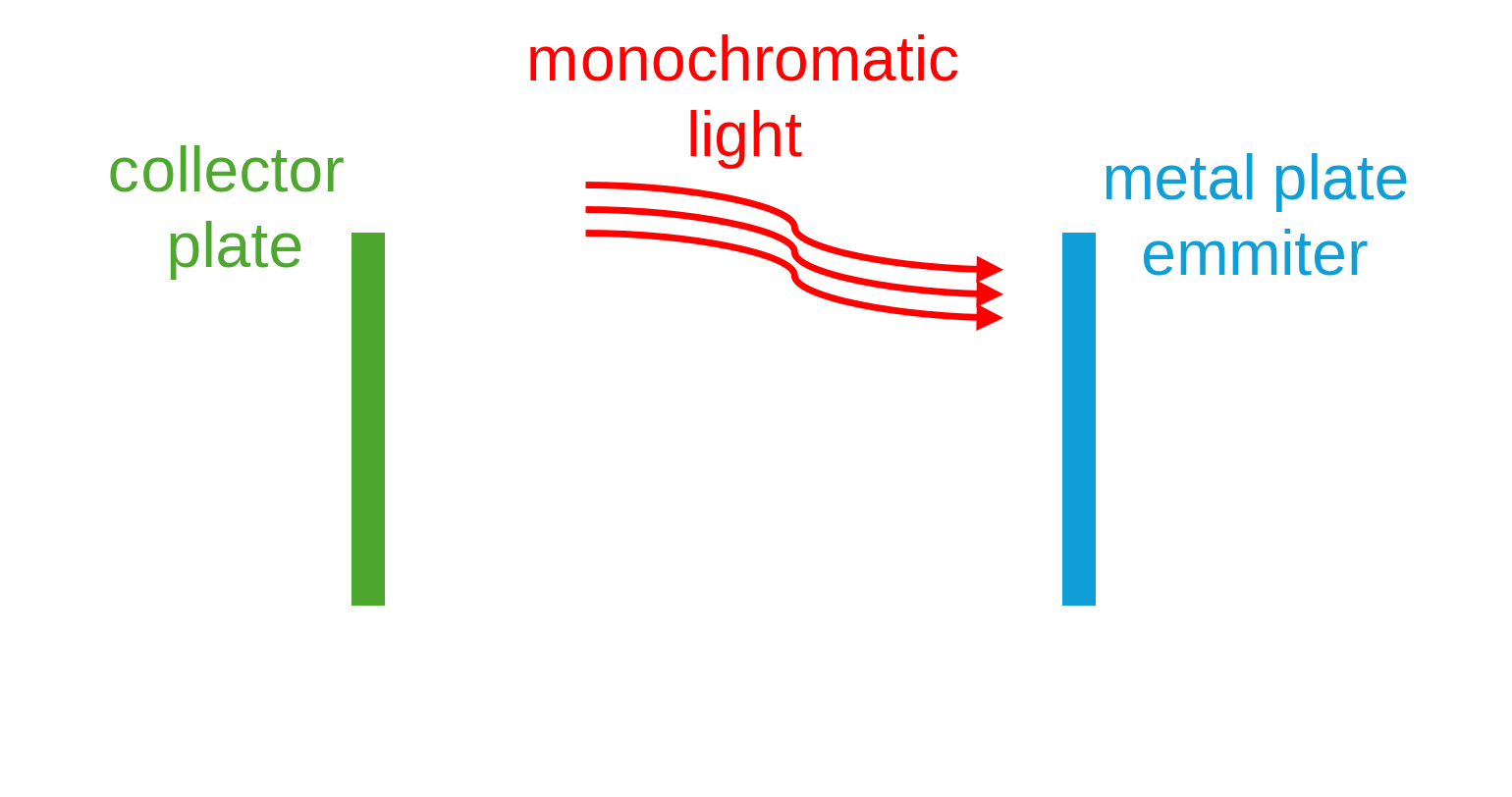
If we shine light onto a metal electrons get emitted if the energy of the photons is high enough.
Light is quantized in packages of .
A light quantum can be transferred to a single electron, which escapes from the metal if
(: work function of metal).
Particles as waves
De Broglie proposed that light has wave like behaviour which a wavelength of
This reltation comes from the discovery that light travels as photons in packets of and that light has energy . De Broglie expanded this to particles. This was later confirmed by the Davisson-Germer experiment. Equivalently one can write